When we chronicle the mythology of Dennis Rodman, the basketball world collectively agrees to organize his career into two distinct, easily digestible buckets.
Bucket A is the Detroit Bad Boys era. Here, he is the hyper-athletic, defensive pest crying after winning Defensive Player of the Year, which was the ultimate agonizing hurdle Michael Jordan had to clear before the Bulls could finally establish their dynasty.
Bucket B is the Chicago Bulls era. He is the tattooed, wedding-dress-wearing, Vegas-trip-taking rebounding savant who seamlessly locked in alongside Jordan and Scottie Pippen to form the most devastating trio of the late 90s.
But as a sports journalist who spends way too much time obsessing over the tectonic shifts of 90s basketball, we have to point out the massive, neon-dyed blind spot in our historical record. We have completely memory-holed a two-year fever dream so chaotic, so thoroughly bizarre, and so culturally mismatched that it belongs in a sociology curriculum just as much as a sports debate.
We need to talk about Dennis Rodman’s stint with the San Antonio Spurs, because it is the ultimate sliding doors moment in modern NBA history.
Let’s reset the chessboard to the fall of 1993. The Spurs were the NBA’s most rigidly professional franchise, built entirely around the pristine aura of David Robinson. The Admiral was the literal poster boy for the league establishment. He was a Naval Academy graduate, a classical pianist, and a chiseled two-way anchor who led by quiet, stoic example. But the Spurs had a glaring structural flaw because they were simply too nice. They kept getting bullied in the postseason trenches by the Karl Malones and Hakeem Olajuwons of the world. They desperately needed an enforcer.
So, they traded for Dennis Rodman. On paper, it was a journalist’s dream and a front-office masterstroke. Put the greatest rebounder alive next to the best rim protector in the league, lock down the paint, and win a championship.
In reality, it was like throwing a lit stick of dynamite into a quiet, exclusive country club.
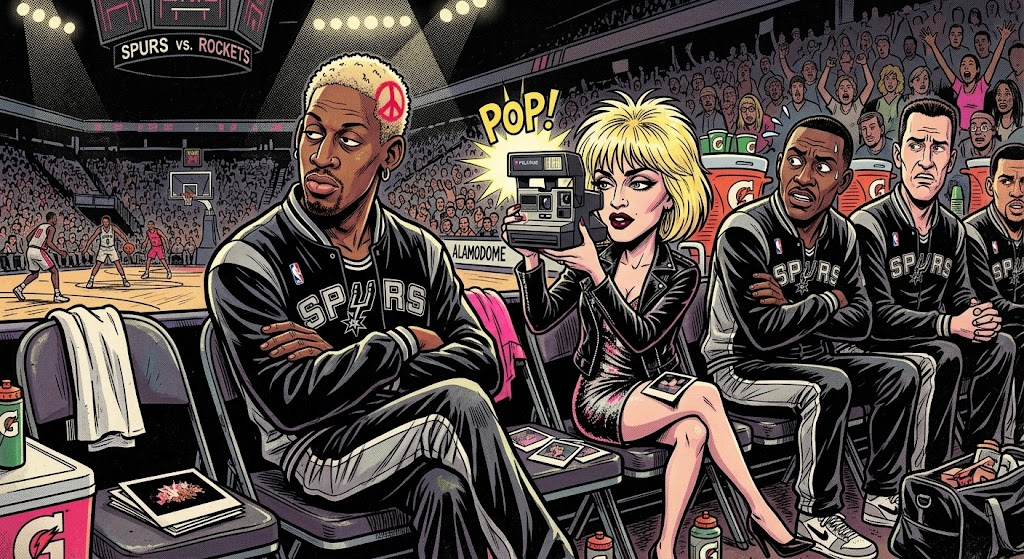
This specific window was the exact moment “Dennis Rodman, quirky defensive specialist” mutated into “Dennis Rodman, full-blown pop culture alien.” He arrived in San Antonio and immediately bleached his hair blonde. Then red. Then he carved a peace sign into it. He started dating Madonna, instantly transforming the sleepy San Antonio media market into a tabloid circus. Madonna was literally sitting courtside at the Alamodome, cheering for a guy who was actively, aggressively refusing to shoot the basketball.
And that is the wildest part of the Spurs era to study on film. Rodman’s basketball brain completely rewired itself into a singular, unadulterated obsession. In his first season in San Antonio in 1993-1994, he led the league with 17.3 rebounds per game while averaging a microscopic 4.7 points. He played 79 games and attempted exactly four three-pointers all year. He would grab an offensive rebound directly under the basket, have an uncontested layup, and forcefully kick the ball back out to Vinny Del Negro on the perimeter just so he could try to grab another rebound when Vinny missed.
His second year is where the statistical anomaly meets the off-court circus. During the 1994-1995 season, he only played 49 games due to a string of team suspensions, unapproved leaves of absence, and a motorcycle accident. Yet despite barely being with the team half the time, he still managed to pull down 16.8 boards a night and capture his fourth consecutive rebounding title while averaging just 7.1 points.
We write endless columns today about modern players stat-hunting, but 1994 Dennis Rodman was the ultimate analytics outlier. He treated professional basketball games like a personal rebounding scavenger hunt.
Then came the culture clash, which is where this story goes from a quirky sidebar to a legendary catastrophe. David Robinson and Dennis Rodman possessed the two most fundamentally incompatible personalities in the history of team sports. Robinson wanted to hold team prayer circles, while Rodman was flying to Vegas on off-days, blowing off practices, and showing up to the arena smelling like a nightclub.
The boiling point arrived during the 1995 playoffs, a stretch of games that completely altered the trajectory of three different franchises. The Spurs had won 62 games. They were the undisputed one-seed. Robinson had just won the MVP. They met the Houston Rockets in the Western Conference Finals, setting up a clash between Robinson and Hakeem Olajuwon.
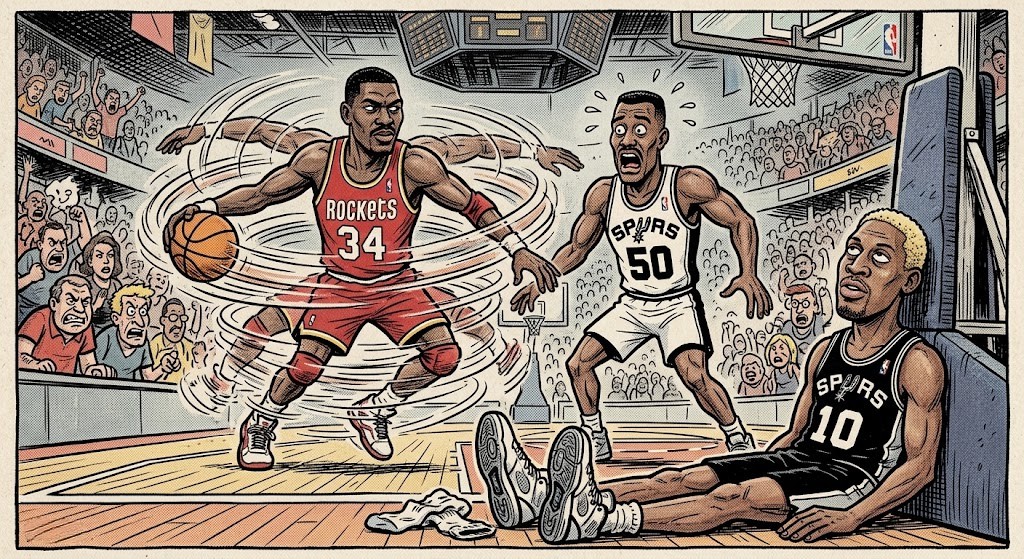
If you are a Body Language Doctor, the 1995 Western Conference Finals is your masterpiece. Hakeem famously took the MVP snub personally and absolutely eviscerated Robinson, executing a series of Dream Shakes so devastating they should be hanging in the Louvre.
But what was Rodman doing while his MVP teammate was getting cooked? He was actively staging a basketball mutiny. Head coach Bob Hill desperately wanted Rodman to double-team Hakeem or at least offer weak-side help. Rodman flat-out refused. He essentially communicated to the coaching staff that since David was the MVP, David should guard him alone.
Rodman spent that entire series throwing a passive-aggressive tantrum on national television. He would show up late to shootarounds. During crucial fourth-quarter timeouts, while the Spurs were desperately trying to figure out how to stop the bleeding, Rodman would wander away from the huddle, sit his 6-foot-7 frame right on the baseline, take his shoes off, and stare vacantly at the Alamodome ceiling. He was completely, undeniably checked out.
The Spurs front office, now heavily influenced by a newly hired and notoriously strict executive named Gregg Popovich, watched this unfold and hit the eject button. Popovich hated Rodman’s antics so fiercely that he traded the greatest rebounder of his generation to the Chicago Bulls for Will Perdue.
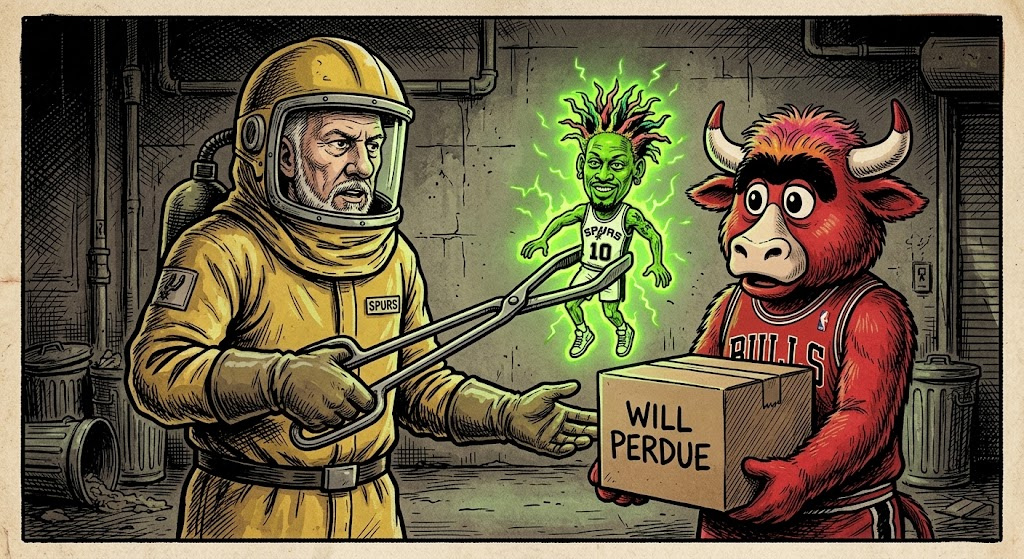
Let that sink in for a second. They traded Dennis Rodman straight up for Will Perdue. It remains one of the most lopsided transactions in NBA history, executed purely because the Spurs viewed Rodman as absolute radioactive waste.
But here is the ultimate twist of fate that changed the league forever. If the Spurs do not trade Rodman for pennies on the dollar, the Bulls never get the exact missing piece they need to ignite their second three-peat. Michael Jordan probably stays at three rings.
Conversely, if the Spurs do not completely implode because of the Rodman experiment, maybe Bob Hill keeps his job a little longer. Maybe David Robinson does not get hurt two years later. Maybe the Spurs never bottom out, never win the draft lottery to select Tim Duncan, and the entire two-decade San Antonio dynasty never happens.
The San Antonio Rodman era was a complete and utter disaster for everyone involved at the time. But historically, it was a beautiful and necessary disaster. For two glorious years, the most buttoned-up franchise in professional sports was held hostage by a guy with pink hair who dated Madonna and refused to shoot layups, and it accidentally birthed two different dynasties in the process.
 HoopersNation
Leave a comment