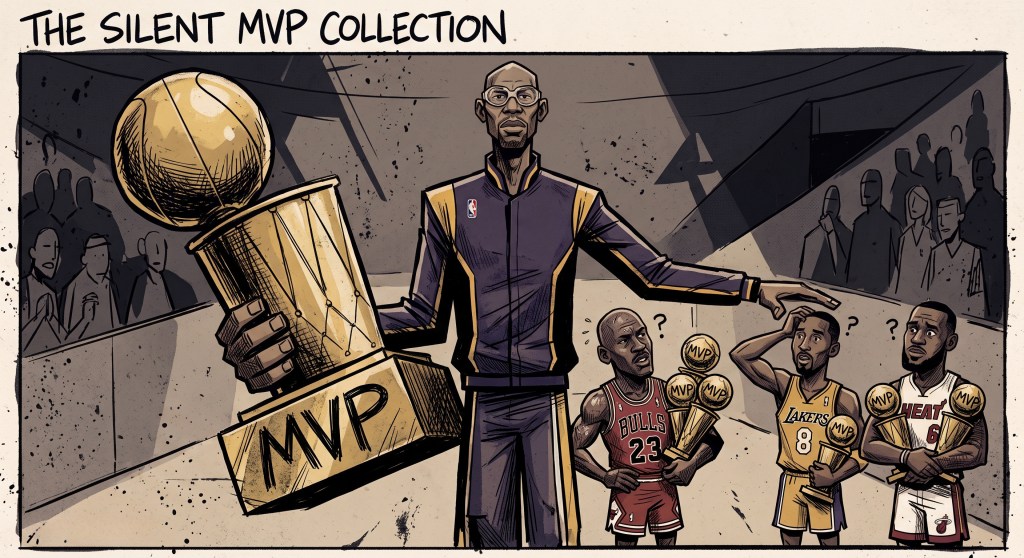
Every six months, the basketball internet collectively agrees to light itself on fire over the exact same argument.
It is always Michael Jordan versus Kobe Bryant. You know the talking points by heart. The Jordan camp waves six rings, two three-peats, and the undisputed status as the original sociopathic basketball assassin. The Kobe camp fires back with five rings, the 81-point game, the absolute mastery of footwork, and a pathological Mamba Mentality that defined an entire generation of hoopers. Both sides dig into their trenches, lobbing killer-instinct anecdotes and highlight clips across the timeline like artillery shells.
We are biologically wired to idolize shooting guards. We love the aesthetics of a 6-foot-6 guard imposing his will on giants. We love the fadeaways, the buzzer-beaters, the scowls, and the theatricality of a perimeter player taking over a game.
Yet standing quietly in the corner, towering over the entire debate with six MVP trophies, six championship rings, and the most unblockable shot in human history, is a 7-foot-2 presence who watches the chaos with mild amusement.
In our relentless urge to crown either the 90s icon in the Air Jordans or his 2000s Los Angeles successor, we have turned the most dominant basketball player who ever walked the earth into the Silent GOAT. We need to have a serious conversation about Kareem Abdul-Jabbar, because history is starting to forget just how untouchable his resume actually is.
The Blind Resume Test
Let us play the pure resume game for a second. If you wiped away the shoe commercials, the charisma bias, and the nostalgic myth-making, and you simply handed a completely objective alien a blind piece of paper with every basketball player’s career achievements, the alien picks Kareem every single time. It is not even a debate.
Start with the hardware. Kareem won six regular-season MVP awards. Michael Jordan won five. Bill Russell has five. Kobe Bryant has one. Nobody in the history of the league has six. He is the all-time leader in Win Shares, playing a brand of basketball so statistically overwhelming that modern analytics models still struggle to properly contextualize it.
Then look at the timeline. Kareem won his first Finals MVP in 1971 with the Milwaukee Bucks, anchoring an expansion team to a championship in just its third year of existence while averaging 27 points and 18.5 rebounds in the Finals. He won his second Finals MVP in 1985 with the Los Angeles Lakers. That is a 14-year gap between Finals MVPs.
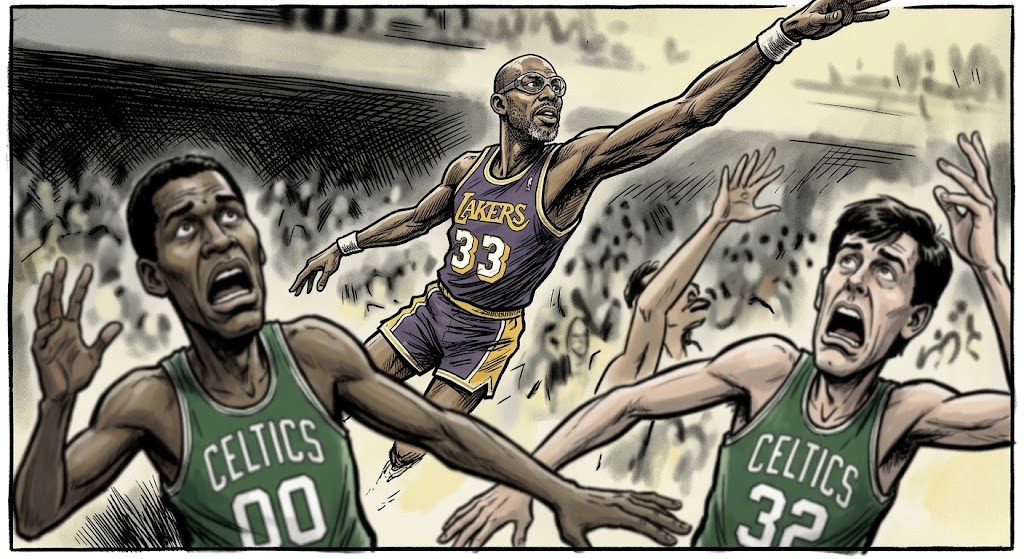
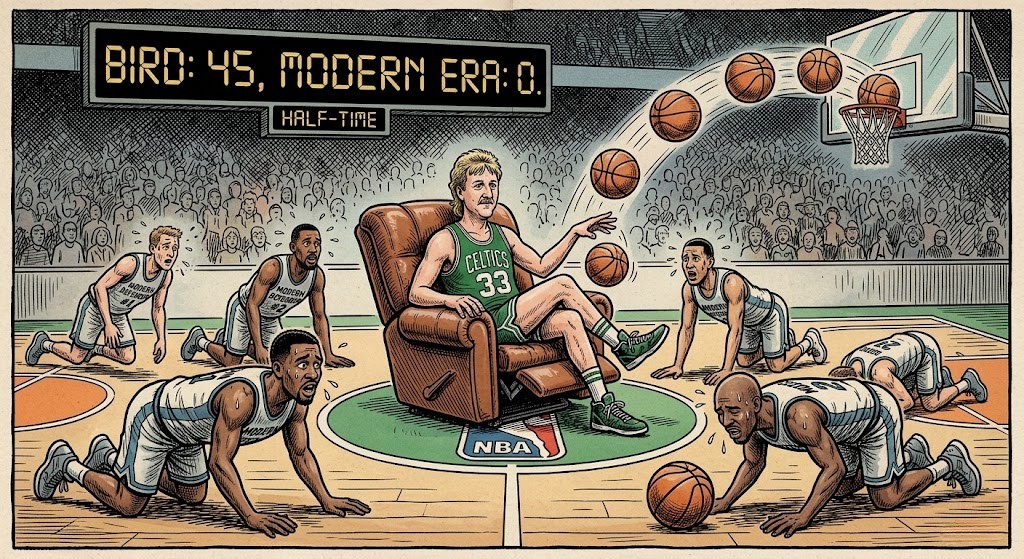
To put that longevity in perspective, in 1985, at 38 years old, Kareem walked into the Boston Garden after getting humiliated in the “Memorial Day Massacre” of Game 1. Everyone wrote him off. The media said he was too old, too slow, and completely washed up against a physical Celtics frontline. Instead, he bounced back to completely dismantle Larry Bird’s Boston dynasty, dropping 30.2 points, 11.3 rebounds, and 6.5 assists across the final four games to banish the Lakers decades-long Boston curse. Doing that to a prime Robert Parish and Kevin McHale at age 38 is a physical impossibility.
If we include the totality of a basketball life, the debate ends before it even begins. At Power Memorial High School in New York City, his team went 79-2, including a 71-game winning streak. He was so heavily recruited that college scouts were practically living in his neighborhood.
At UCLA under John Wooden, he went 88-2 and won three consecutive national championships. The lore of his college days sounds completely fabricated. Because freshmen were not allowed to play varsity basketball at the time, Kareem played on the freshman squad. That freshman squad actually played an exhibition game against the reigning national champion UCLA varsity team, and Kareem’s freshman team blew them out. He was so dominant that the NCAA literally banned the dunk for an entire decade simply because he was using it to turn college basketball into a laugher. They changed the fundamental rules of the sport just to give the rest of the country a fighting chance.
When you tally it up from high school through his retirement at age 42, the man barely lost 100 meaningful games of basketball in three full decades.
The PR Problem of the 1970s
So why isn’t he universally accepted as the greatest? Why does he constantly get relegated to the bronze medal in the modern barbershop debate?
The answer has nothing to do with basketball and everything to do with narrative, timing, and public relations.
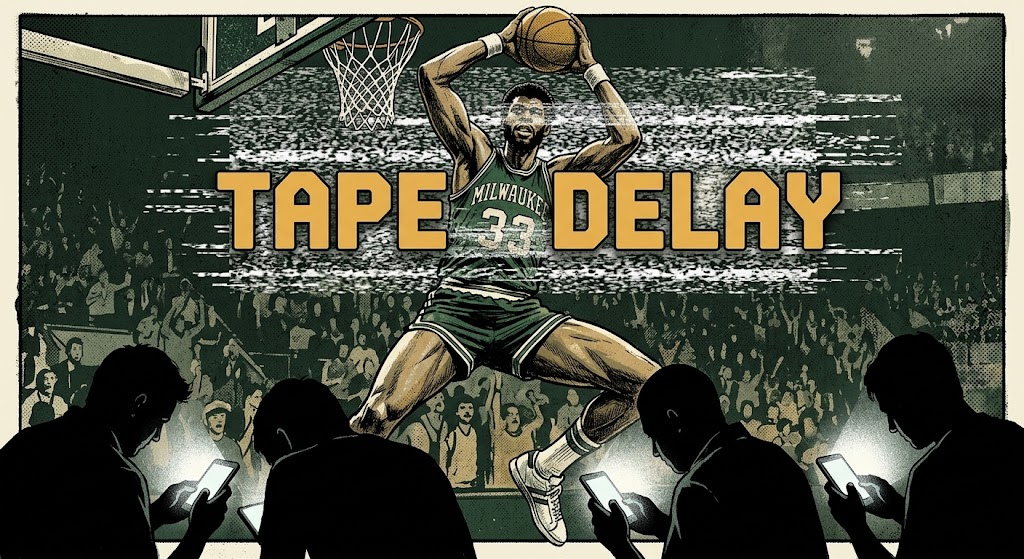
First, Kareem spent his absolute physical prime dominating the 1970s, which is widely considered the NBA’s forgotten decade. It was an era of tape-delay Finals broadcasts, fractured television deals, the chaotic ABA merger, and rampant league-wide substance abuse scandals. The casual sports public simply was not plugged into basketball the way it would be once the Bird-Magic rivalry and David Stern revolutionized the product in the 1980s. If you dropped 1972 Kareem into the modern NBA, he is averaging 35 and 15 and winning unanimous MVPs, but because his most dominant athletic years happened off the national radar, they are treated as historical footnotes.
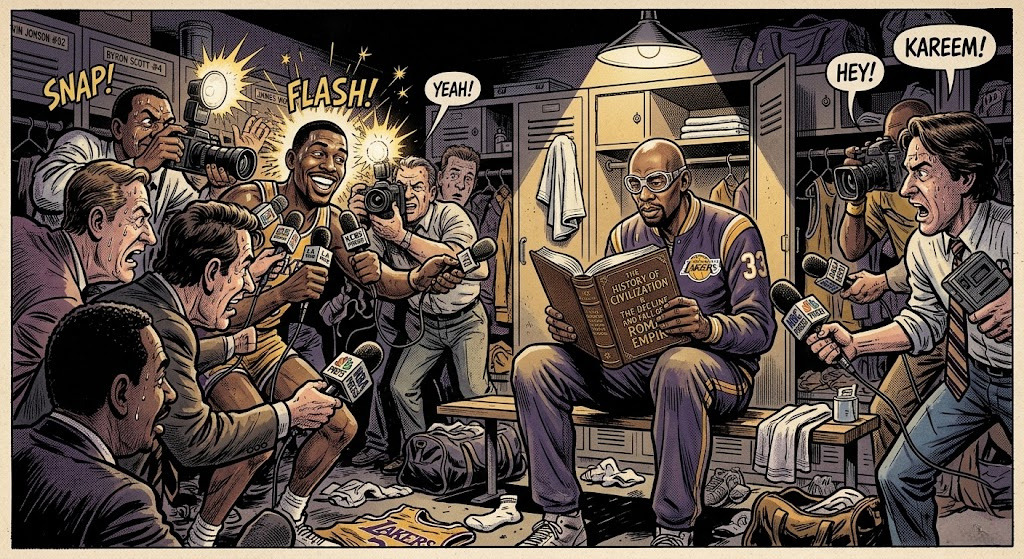
Second, Kareem refused to play the media game. He was not smiling for cereal boxes, and he was not offering easy soundbites to local reporters. He was an intense, highly intellectual introvert who converted to Islam, took a proud and uncompromising stand for civil rights, boycotted the 1968 Olympics, and preferred reading historical biographies in the locker room over schmoozing with beat writers.
The media of that era often labeled him aloof, sullen, or difficult, primarily because he refused to give them access. He viewed the press with a deep, earned suspicion. In the era before social media, the sports writers controlled the entire narrative. Because Kareem did not cater to them, they rarely went out of their way to build his mythology the way they did for other stars.
The Showtime Paradox
This dynamic came to a head when Magic Johnson arrived in 1979. Magic was everything Kareem was not. He had a hundred-watt smile, he embraced the spotlight, he loved the media, and he played a flashy, fast-paced style that perfectly suited the emerging television era.
The casual fan gladly credited Magic with saving the Lakers, conveniently forgetting that Kareem was still the structural backbone of the entire Showtime machine. Magic was the engine, but Kareem was the chassis. When the Lakers needed a guaranteed bucket in a half-court set during the fourth quarter of a playoff game, they were not running a fast break. They were dumping the ball into the post to the captain.
Kareem won the MVP award in Magic’s rookie season. He remained an elite, All-NBA caliber center well into his late 30s. Yet, because he was the stoic veteran standing next to the most charismatic point guard of all time, his contributions were subtly downgraded in the public consciousness from “franchise savior” to “reliable co-star.”
The Ultimate Weapon
Finally, there is the weapon itself. We have to talk about the Skyhook.
The Skyhook was the single most devastating, unguardable offensive move in sports history. It was graceful, geometric, and utterly unstoppable. He would receive the ball on the block, turn his shoulder to protect the rock, plant his foot, and launch his body into a sweeping, sweeping arc. Because the ball was released at the very top of his extension, combined with his 7-foot-2 frame and immense wingspan, the release point was essentially 11 feet in the air.
You could not block it. You could not alter it. You could only hope he missed.
But because it looked like an elegant ballet routine rather than a violent, backboard-shattering dunk or a contested Kobe fadeaway jumper, modern highlight reels treat it like a dusty relic. We celebrate the flash of Jordan floating from the free-throw line or Kobe hitting a game-winner through a double team, yet we ignore a shot that generated 38,387 points without ever giving a defender a prayer of altering it. The modern fan equates difficulty and aesthetic beauty with greatness. The Skyhook was so fundamentally perfect that it made scoring look boring.
The Final Verdict
When evaluating the greatest player of all time, we have to decide what actually matters.
If your definition of the GOAT requires the loudest marketing campaign, the most theatrical highlight reel, the most ruthless on-court trash talk, and the coolest sneakers, then Kareem Abdul-Jabbar will never be your guy. He is not going to win a popularity contest against Michael Jordan or Kobe Bryant.
But if the criteria is absolute basketball mastery, unmatched collegiate and professional dominance, unprecedented longevity, and a resume that remains untouchable decades after retirement, the case is completely closed.
Kareem did not need a global marketing machine to tell us he was the best. He did not need a slick nickname or a signature shoe. He simply walked onto the court, dominated his era more thoroughly than anyone before or since, and walked off with six rings. The trophy case does all the talking for him, whether the internet wants to listen or not.
 HoopersNation
Leave a comment